
JADES Team Discovers Thousands of Galaxies In the Early Universe
The JADES team has released Data Release 5 (“DR5”), a uniquely comprehensive view of the Universe in the GOODS-S and GOODS-N fields. You can read the recently released papers to see what is included in this data release and learn about the half-a-million unique galaxies that comprise this full catalog. Across the 469 square arcminutes, we find an incredible 2081 galaxies and candidate galaxies at z > 8, a redshift that puts them within the first 600 million years after the Big Bang.
Building off of work done with DR2 in 2023, a JADES research team lead by Kevin Hainline searched through the GOODS-S and GOODS-N galaxies for sources with the telltale markers of being at high redshift, performing careful fitting and visual inspection to uncover a robust sample of sources that span a wide range of brightnesses and redshifts. In this sample, only 123 sources have been confirmed spectroscopically, including the bright, extended galaxy JADES-GS-z14-0 at z = 14.18.
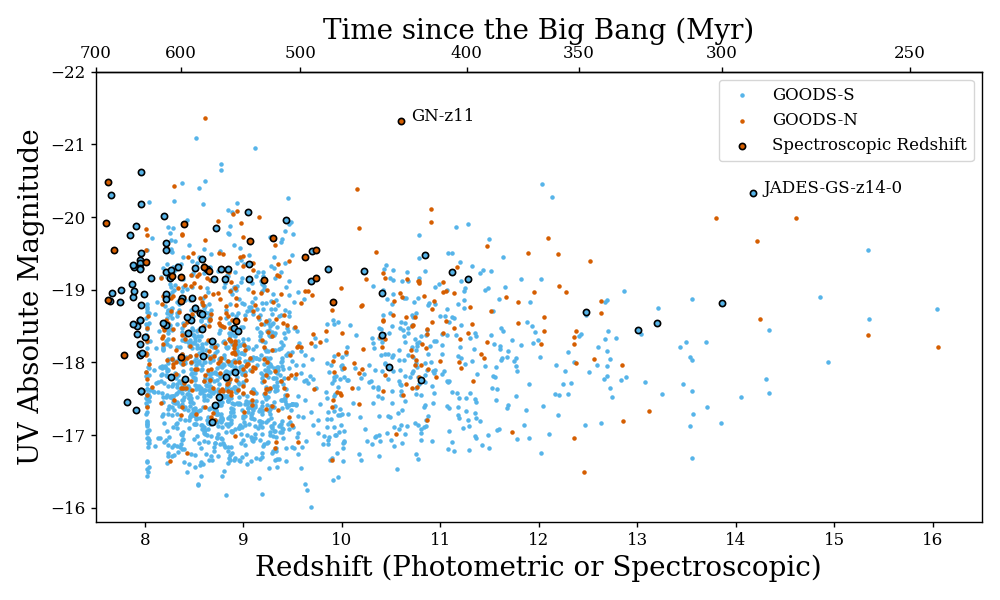
Here we plot the intrinsic brightness of the source against its redshift, where we show the GOODS-S sources with blue circles and the GOODS-N sources with red circles. The sources with spectroscopic confirmation are shown with dark circles. The full dataset can be downloaded at this Zenodo link, with photometry and other derived parameters from fits and imaging analysis for the sample.
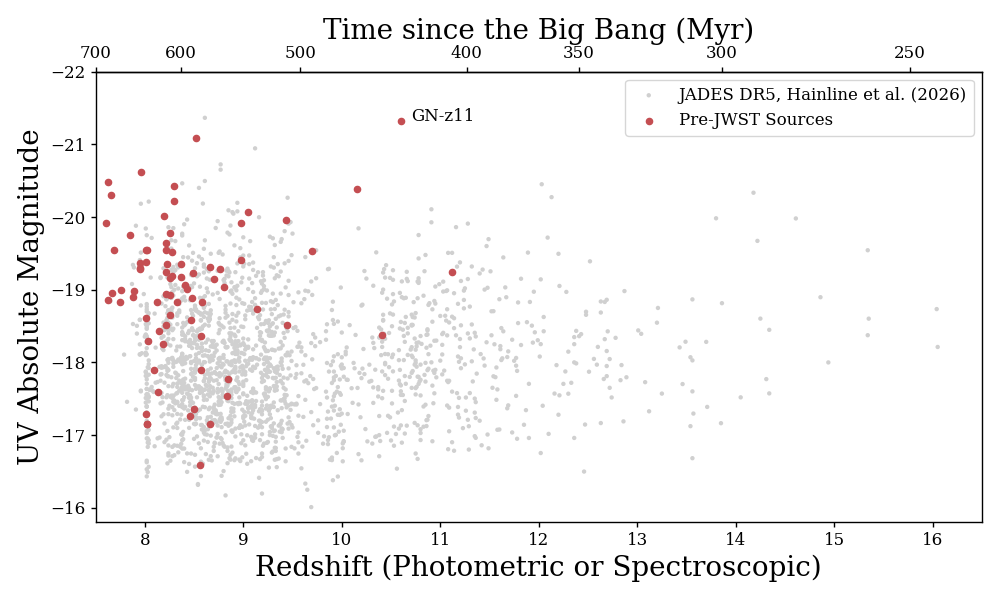
The sources found in the JADES DR5 z > 8 sample span two well-studied regions, GOODS-S and GOODS-N, which were observed by many astronomers in the decades leading up to the launch of JWST. Prior to 2021, there were only 85 galaxies in this sample (4%) that had been previously identified, demonstrating the power of JWST observations to find both distant and intrinsically faint galaxies at Cosmic Dawn.
This sample builds off of previous JADES work in Hainline et al. (2023), spanning a significantly larger region, including a number of ancillary datasets in GOODS-S and GOODS-N. With this new sample, we find 1347 new galaxies (65% of the full sample), including objects never before identified with photometric redshifts at z > 14.
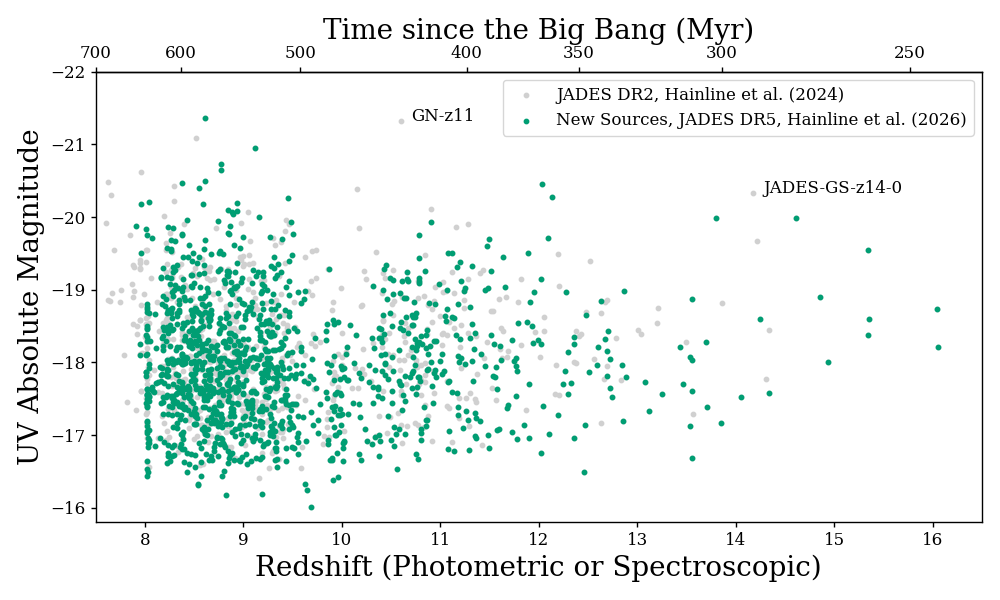
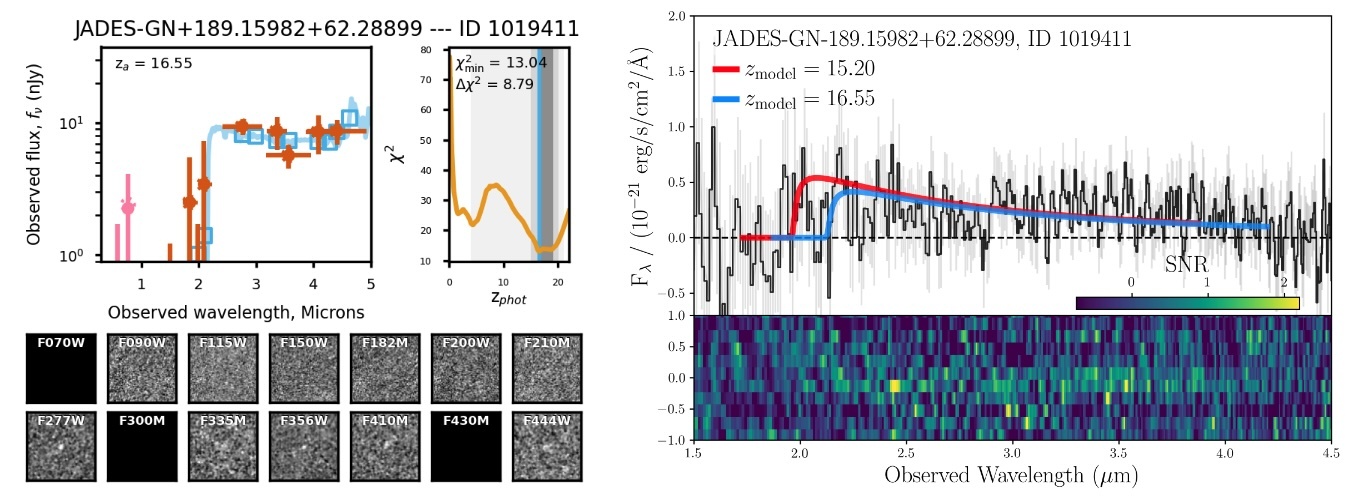
The highest-redshift sources are still just candidates, as deep spectroscopy is needed to confirm their redshifts, but they represent a promising sample for understanding the first galaxies that arose out of the Cosmic Dark Ages only a few hundred million years after the Big Bang. One source, originally discovered in Hainline et al. (2024), JADES-GN+189.15982+62.28899 (ID 1019411), has photometric and spectroscopic evidence for being at z = 16.55, although at low significance. If confirmed, we would be observing this source when the Universe was only 236 million years old.
The full paper explores the ultraviolet properties of the sample, demonstrating how varied star formation was in the early Universe, as well as their shapes. A full quarter of the sources, regardless of redshift, have some evidence for being morphologically extended, with these galaxies showing flattened morphologies, or multiple knots and clumps.
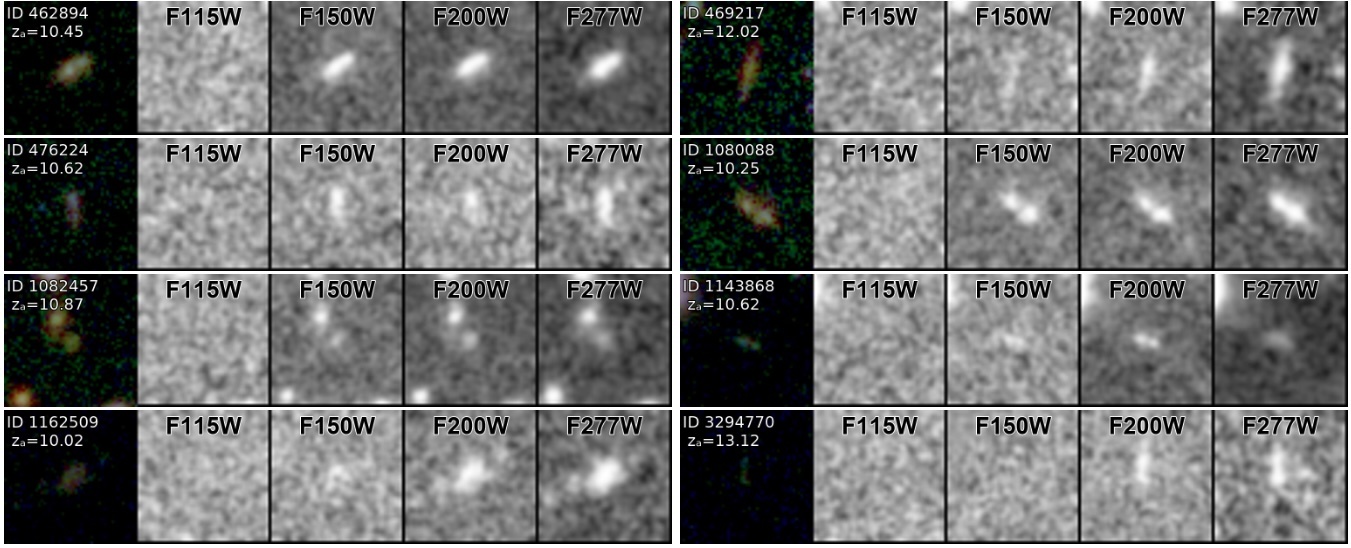
The complex morphologies for these objects demonstrates how early galaxies are growing through mergers and in knots of star formation. Each of these sources can be seen in the JADES FITSmap viewer, by searching for their ID, where you can view the SED, and see the sources in each of the HST, NIRCam, and MIRI filters.
A separate study, by Zihao Wu, explores a subsample of these objects in GOODS-S, finding a growing “overdensity” of sources at z = 10.5, likely part of a large complex of galaxies that may be gravitationally bound, potentially the earliest stages of a supercluster.
The discovery of these distant galaxies represents a realization of one of the primary scientific themes of JWST, showing us the first light in the Universe. The JADES DR5 dataset is a culmination of decades of work by the JADES GTO team and many other independent research groups who have observed data in GOODS-S and GOODS-N, and we are very hopeful for the future analysis and confirmation of these distant sources.